Storage: LiFePO4 Home Battery Pairing
In an era of slashed utility export tariffs, self-consuming your midday solar generation via safe, long-life Lithium Iron Phosphate chemistry is no longer an luxury—it is an economic imperative.
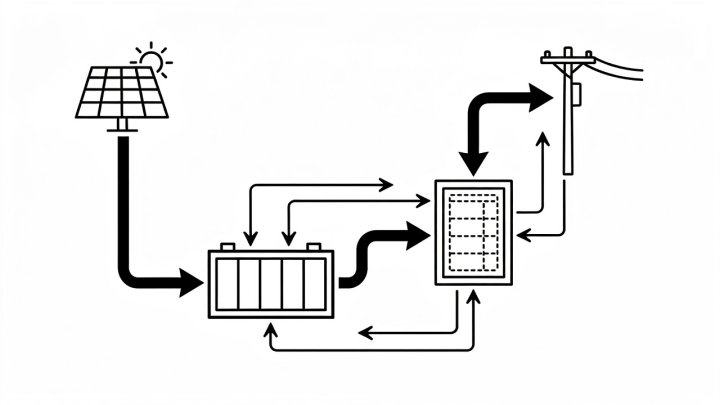
Lithium Iron Phosphate (LFP) vs Nickel Manganese Cobalt (NMC)
Early home batteries (including first-generation Tesla Powerwalls and LG Chem RESU units) relied on Nickel Manganese Cobalt (NMC) cathode chemistries adapted from electric vehicles. While NMC offers superior gravimetric energy density (saving wall space), it carries severe thermal runaway risks if punctured or overheated, with combustion temperatures starting around 210°C (410°F).
The residential energy sector has decisively transitioned to Lithium Iron Phosphate (LiFePO4 / LFP) (utilized by Enphase IQ Battery 5P, FranklinWH, Tesla Powerwall 3, and EG4). LFP features extremely robust covalent phosphorus-oxygen bonds. It resists thermal decomposition up to 500°C (932°F) and produces virtually zero released oxygen during puncture testing, making indoor garage installation profoundly safer.
| Performance Parameter | LiFePO4 (LFP) | NMC (Nickel Cobalt) |
|---|---|---|
| Thermal Runaway Threshold | ~500 °C (Extremely Safe) | ~210 °C (Requires cooling) |
| Cycle Life (to 80% Capacity) | 6,000 - 8,000 Cycles | 2,500 - 3,500 Cycles |
| Usable Depth of Discharge (DoD) | 100% Usable | 90% - 95% |
| Cobalt Contaminants | 0% (Ethical supply chain) | Significant |
| Expected Calendar Lifespan | 15 to 20 Years | 8 to 10 Years |
Time-of-Use Arbitrage and Round-Trip Efficiency
Batteries lose energy in both charging and discharging due to electrical resistance and DC-to-AC conversion. Premium LFP systems deliver a Round-Trip Efficiency (RTE) between 89% and 92%.
To generate profit through Time-of-Use (TOU) arbitrage, the price spread between your utility's off-peak charging window (or free solar export credit) and peak evening consumption must exceed the battery's levelized cycling cost (typically calculated at $0.09 - $0.12/kWh). In utilities charging $0.48/kWh between 4 PM and 9 PM versus an avoided-cost export credit of $0.05/kWh, storing and consuming your own power yields immediate daily cash savings.
Whole-Home vs Critical Loads Backup
A standard 10 kWh battery provides roughly 3.84 kW of continuous output. Powering heavy inductive loads such as central 4-ton air conditioners or heat pumps requires either soft-starter capacitor kits or pairing two modular batteries in parallel to satisfy peak inrush surge currents (LRA).